


1. Introduction
CAM has become one of the fastest growing remedial approaches. It has already achieved very distinctive reliability and eminence outside territory of traditional medicine system due to their various therapeutic attributes. Some forms of CAM have been practiced for centuries, whereas others like electrotherapy are more recent in origin.1 Acupressure is one of the known CAM practices across the world. It is based on fundamental principle of activation of acupoints across the meridians. Activation of acupoints is facilitated by use of fingers or the simply available various hand-held acupressure devices. Due to easy and safe manual (hands-on) therapy, acupressure is exercised by number of people across the globe. As these are often used in people to build health and as remedy for various ailments, it’s essential to have knowledge about the current acupressure techniques along with investigation of its scientific and biomedical scope.
2. Acupressure
Acupressure was originated in ancient China.2 It showed superior therapeutic potential against numerous disease conditions. Acupressure is a type of acupuncture. Both acupressure and acupuncture are based on same fundamental principle of acupoints activation across the meridians. In acupressure, muscular tension is released by applying pressure with hand at specific acupoints or pressure of the thumbs on specific points or the application of pressure to acupoints is used to balance the flow of the physiological energy.3, 4 Acupressure also resembles reflexology; however in reflexology therapeutic response was obtained by work on predetermined reflux zone.5 Acupressure demand application of physical pressure on trigger points/acupoints/specific pressure points which are positioned along the meridians. Meridians are the channels within human body which helps to maintain Qi and thus, steadiness of health condition. Each meridian is connected to various organs and tissues of human body. Activation of specific point on meridian by pressure facilitates pain reduction at the local site and also reduces the pain from other parts of the body.6 It is a pressure point, hand-mediated energy healing technique which is considered as useful strategy for the management of multiple symptoms, along with beneficial physical comforts, satisfaction and economy.2, 7 As a whole, acupressure is a manually operated, needle-free, non-invasive, cost-effective and non-pharmacological healing intervention to promote patients’ well-being.
2.1. Acupoints
Entire human body is a cluster of pressure points.8 Acupoint is the point closest to the surface of the skin and activation of acupoint is the prime step in acupressure.9 Stimulation of specified acupoints is known to elicit functional responses that can be used to treat diseases.10 Acupoints are any specific points for needle insertion in acupressure; mostly these are area of high electrical conductance on the body surface.4 Each acupoint possess a different sensation based on the body part which suffers from the pain or a specific problem. Simply, application of pressure at different points cause different effects.11, 12 Acupuncture points per se have different physical effects according to location.13 Location of each acupoint on specified meridian is determined in terms of body inch (BI) or Cun. One BI/Cun equals one thumb width at the base of the finger nail.14 BI/Cun are known as acupressure units of measurement (AUM).
Local Points (LP) and Distal Points (DP) are the two important acupoints, employed by acupressurists to treat the patients in routine clinical practice. Acupuncture and acupressure show different physiological effects on these points. Application of acupressure on only LP exhibits the therapeutic response on autonomic nervous system. Tender points (TP) are the third type of acupoints present on nociceptors and polymodal receptors. Activation of such TP sensitized polymodal receptors result in better effects on pain relief.15 In acupressure, acupoints can be activated by elbows, fingers, feet, knuckles, palms, thumb or specific tools. In ancient China, acupoints were activated with the help of stones, known as Bian Stones.5 Currently, numerous acupressure or elastic bands with a protruding plastic button are available.16
2.2. Mechanism of action
Qi permeates everything and it is vital energy of life. It is the quality attribute that determines the state of one’s health. Yin and Yang are customary medicinal traits conflicting as well as in equilibrium with each other.17 In accordance to traditional Chinese medicine (TCM), acupressure uses pressure to stimulate specific acupoints for therapeutic purposes and stimulating these points can correct imbalance between Qi through channels and subsequently treat the diseases.18 Re-equilibrium of Qi achieve therapeutic benefits by improving the physiological functions of body systems or Zang-fu in the process.19 Zang-fu is a combined term for human internal organs; five zang organs are the heart, liver, spleen, lungs and kidneys, along with the six fu organs involve gallbladder, stomach, small intestine, large intestine, urinary bladder and sanjiao (the triple energizer).20 It is simply a non-pharmacological intervention on the body to treat a wide range of conditions by applied pressure to specific acupoints.21 It is the massage of acupoints performed with the fingertips, knuckles, thumbs, elbows or suitable devices to achieve effective treatment that would last from several minutes to hours post a single treat-ment.2, 22, 23 Acupressure is a multi-modal therapy whose working mechanism can be elucidated by miscellaneous theories.24
According to Gate Control Theory by Melzack and Wall, acupressure at specific point passes pleasurable impulses to the brain at a rate four times faster than painful stimuli. Continuous impulses shut the neural ‘GATES’ and slower messages of pain are blocked from reaching the brain and helps to improve or strengthen the pain perception threshold of body.25 Based on the location of stimulation, pressure-generation activates the small myelin nerves in the muscles and pass stimulations to the higher nerve centres including spinal cord, midbrain, hypothalamus and pituitary axis.26 Magnetoencephalography (MEG) studies demonstrated conditioning of primary somatosensory response during the acupressure. In addition to sub-cortical effects on endogenous pain regulation acupressure also exhibits potential for affecting primary somatosensory processing and possibly altering maladaptive neuroplasticity.27 Auricular acupressure (AA), a micro-acupuncture is a non-invasive technique similar to reflexology in which endocrine functions are improved effectively. It is known to exert its effects via stimulating the central nervous system through the cranial/spinal nerves on the auricle of the ear.28, 29
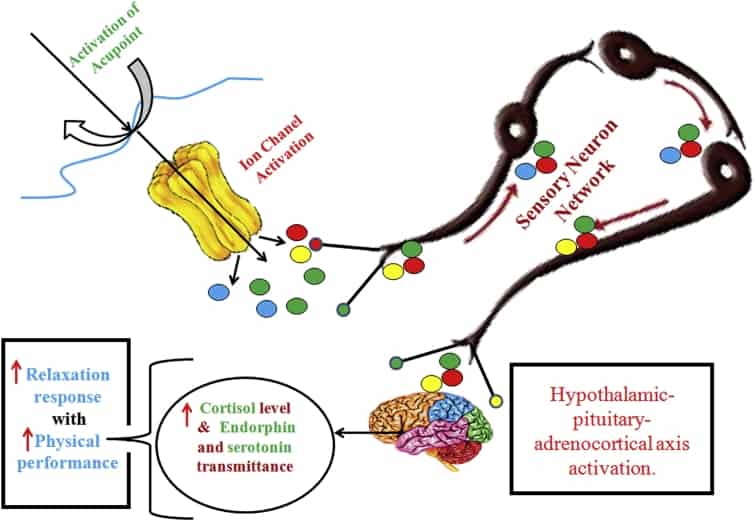
Biochemical mechanism (Fig. 1) of acupressure involves the stimulation of acupoints that leads to complex neuro-hormonal responses.30 It involves the counteraction among hypothalamic-pituitary-adrenocortical axis that leads to overproduction of cortisol and cause a relaxation response.31 Also, it modulates the physiological response by increasing endorphin and serotonin transmittance to the brain and specific organs through nerves and meridians.32, 33, 34 After exercise, restorative meridian acupressure helps to change the concentration of stress hormones and lactic acid.35 Specifically in case of the respiratory function, acupressure plays a moderating role. Activation of acupoint activates myelinated neural fibres that stimulate the hypothalamus and pituitary gland, leading to the release of β-endorphins from the hypothalamus into the spinal fluid and pituitary into the blood stream, respectively. Thus, the analgesic and sedative effect of β-endorphins facilitates the normal respiratory function of patient.36